10 Common CMR Errors That Stop Cargo at the Border | CMRDocs
Discover the 10 most common CMR consignment note errors that cause border delays, customs holds and fines — plus a pre-issue checklist for freight companies.
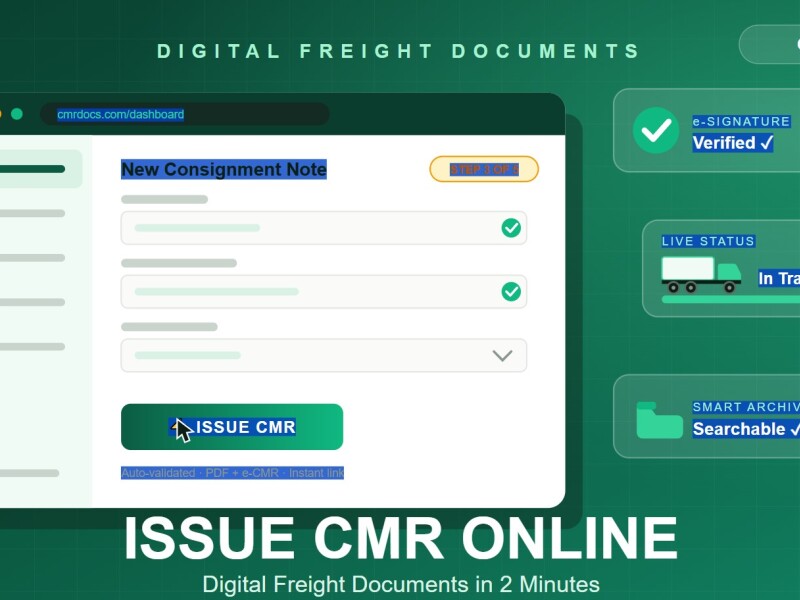
Every year, thousands of trucks are held at customs posts across Iran, Türkiye, Armenia, Georgia and the EU for one simple reason: a mistake on the CMR consignment note. Border officers compare the CMR line by line against the commercial invoice, packing list and TIR documents. Even a small mismatch means a hold, storage costs, and an unhappy customer. Here are the ten errors freight forwarders say cause most border stops — and how to prevent them.
The CMR consignment note is the mother document of road freight: every correction must be clean, recorded and signed, and any ambiguity in its content is interpreted against the carrier in legal disputes.
The 10 Errors That Get Your Truck Held
- Weight & package-count mismatch
The number-one reason for holds. If the weight on the CMR differs from the invoice or packing list by even a few kilograms, customs can order a re-weigh and inspection. Always cross-check the CMR against the packing list before issuing.
- Incomplete consignee details
A missing tax identifier (EORI in the EU), a vague address or a wrong contact number invites extra checks. Enter the full legal name, address and tax ID of the consignee.
- Vague goods description
"Spare parts" is not a description. Customs classifies your cargo by what you write; ambiguity is treated as risk. State the exact nature of the goods and, where required, the HS code.
- Wrong place of taking over / delivery
The countries and localities in these fields must match the actual route and the TIR or transit declaration. A wrong country of origin questions the entire routing.
- Empty "carrier's instructions" field
Temperature control, dangerous goods (ADR), attached documents: if it is not on the CMR, it does not exist at the border. Anything that makes your load special must be recorded in the carrier's instructions.
- Missing signatures and stamps
The driver must sign on collection and the carrier keeps the first copy. An unsigned CMR is legally defective and raises questions at every checkpoint.
- Errors in the carriage charges field
Freight charges, supplementary costs and cash-on-delivery amounts must match the tariff agreement. A wrong "carriage to be paid at destination" can freeze the entire delivery.
- Illegible handwriting and unmanaged corrections
Overwriting without striking through and initialing makes the document suspect. Corrections must be made cleanly and signed by the issuing party.
- No remarks recorded at delivery
If goods arrive damaged or late, observations must be recorded on the CMR at that moment. Forgetting this can kill the insurance claim — the CMR is your primary evidence under the CMR Convention.
- Using non-standard forms
Some contracting states reject consignment notes that miss mandatory fields. Use a standard CMR layout — or better, a software-validated e-CMR.
Pre-Issue Checklist
| What to check | CMR field | Match against |
|---|---|---|
| Weight & packages | Gross weight / packages | Packing list & invoice |
| Consignee | Consignee | Commercial invoice |
| Goods description | Goods description + HS code | Commercial invoice |
| Routing | Place of taking over / delivery | TIR & transit docs |
| Instructions | Carrier's instructions | ADR / temperature requirements |
| Charges | Carriage charges | Tariff agreement |
FAQ
Can I correct a CMR after it has been issued?
Yes — amendments are possible before delivery, provided all parties are informed and the change is properly recorded. See our full guide: How to Amend or Reissue a CMR.
What happens if the driver loses the CMR?
You can issue a certified duplicate marked as replacing the void original. Keeping a digital copy eliminates this risk.
Is the electronic e-CMR legally valid?
Yes. The e-CMR Protocol entered into force in 2019 and is legally equivalent to the paper note in acceding countries (UNECE).
Try the online demo and issue your first CMR in 2 minutes.
🚛 View the Online CMR Demo
دیدگاهها